
“If I can’t do something for the public good, what the hell am I doing?”
Anita Roddick
The fragility of the provision of public goods
In the modern times, we are on the land of freedom but under the shadows of the state’s iron grates. Behind the grates, our possessions, kids, ideas, and even ourselves are under the risk of being a public good
First and foremost, what does the term of public good refer?
Public goods are often used to describe the things are non-rivalrous such as fresh-air, knowledge or common languages, or those are ‘beneficial’ to the public like education, parks, roads.
Samuelson (1954) smoothly defines public good as
which all enjoy in common in the sense that each individual’s consumption of such a good leads to no subtractions from any other individual’s consumption of that good
Well, one way or another, we are eventually the creator of the goods, regardless of their public or private characteristics. Humbly speaking, we are working from sun to sun to be the ‘benefactor of humanity’:
We are the producers of gross domestic products. We are the policy-makers, strategic planners or CEOs. At a micro level, we are responsible for our well-being and starts physical self-care.
As a benefactor of humanity, we somehow contribute to the “common interest”
Some work at the hospitals or universities to make an education system publicly ‘beneficial’. Others design, construct and repair the bridges, roads, gardens or even develop sophisticated clean-air technologies. As a producer of goods, everyone contributes to the economic and cultural development of the societies to some extent.
Nevertheless, the grimmer battle outbreaks when the notions of “ownership” and public goods contradict each other.
Historically, those people who create the things are more likely not the same ones who also possess them. Then, who own the public goods even though the fact that we are all contributing to the process the public goods?
The Concept of the State as the “Protector”
The state, herein calls dibs on us:
The citizenship and the public goods are the natural rights of all human beings, and I, theıre, am here to protect above-mentioned rights of yours.
Halleluja!
Then, as a matter of course, the Holly State protects the very right of public goods as against our waiving the rights on them. Hence, we all consider the park just across to our lovely home as a property of the state, not mine, nor yours.
On the other hand, the Paternal State approach of the state (the state as our beloved protector and the Holly supplier in the name of God or democracy) is criticized by the understanding putting “me” over the state.
Therefore, I own my body, my kids, my possessions, my beloved ones, but the State. The vicious cycle continues, and we believe that we have rights to place all under our guardianship and encourage them for the sake of self-betterment.
Luckily, liberal economies all around the world support this individualistic approach and force the State to waive its any right on the personal accumulation, savings, belongings except placing a tax on them.
Eventually, we reached a point where the naive borders between what we own and what the state has an authority on leaving us hanging in midair.
What about the ownership of the kids?
Are the kids for the sake of family or for the sake of the state, or apart from these, for the sake of their own? Who is the sovereign of the kids and to whom they belong?
In the modern liberal world, it is pretty clear that we partly own what we produce or what we buy.
And of course, our kids, as the most precious “products” of us, do not fall outside this liberal doctrine.
So here is the most asked question: Are kids private goods or the public ones?
Who has a right to determine the kid’s fate? Do we have any effective power on what they think, decide, believe, wear or to with whom they fall in love? At the same time, why should we consider- and to what extent- kids as public goods?
It is obvious that raising a child within the modern societies is not an easy and “cheap” task. It lays a burden on the families’ shoulders thanks to the liberal economy’s favoring ideas on the individual responsibilities
Let every tub stand on its own bottom.
Eventually, the families got the nod and the kids are labeled by the surnames, kinship ties and are brought up within the lovely modern nuclear families where the families ought to follow their parental duties as having primary authority over a kid.
So far so good.
But what about the roles of the State taking a part in the game?
Common Welfare in the Society
To date, the State´s main duty has been maintaining the desired security level and (common) life satisfaction of the society. Interestingly, the security level and life satisfaction of a society are highly correlated with the others who live around us.
Average (the others’) well-being, education levels, and moral values, as well as people’s approaches to the environmental issues such as respecting the recycling regulations or preserving the optimum personal hygiene level, are keys to fulfilling such standards.
All can partly be achieved by the hands of the State after establishing some regulations, such as public education, aiming to increase a conscious awareness about being responsible citizenship and to encourage the moral values in relation to the “common welfare in the society”.
The idea is straightforward: ass the twig is bent so grows the tree.
Therefore, once a compulsory education made, it is assumed that the level of crimes is more likely to decline and the awareness of being a responsible citizen and being respectful in public matters are more likely to happen.
Knowledge economy
Besides the necessity of a basic level of education for the sake of public safety, to meet the needs of the knowledge economy is another significant aspect of collective welfare. As Andersen (2009) states, with the competitive features of the globalization, individuals not only need to be educated at the adequate level to understand today’s world but also they need to push forward the society to further level with their acquired knowledge and abilities.
He also asserts that the best stage during the life course to deal with this issue is childhood. In case the State supports to the high quality of education until the kids reach a reasonable age, every child should have an opportunity to reveal their potential and hereby, they all will pricelessly contribute to the betterment of the society.
It does not mean that all children would be considered as possessions of the state as mentioned in Plato’s his worthy book, State. Instead, the state as a result of its existence in the modern life ought to ensure a basic and advanced level of public education to its children for the sake of a better society.
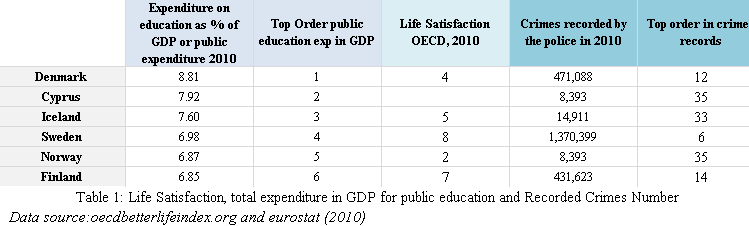
The higher average education and awareness levels within the society are positively correlated with satisfaction level for life satisfaction. For instance, in Table 1 summarize cross-national differences in total public expenditure on the education ( % of GDP), OECD’s life satisfaction index, and total crimes record all of which highlight the importance of the education to maintain the social and personal welfare
The Balance of the See-saw
Although the State is still one of the most prominent responsible institutes in the modern societies to cultivate children through the formal education, it is apparent that we enjoy the kind and comparably flexible life in which most of the decisions can be taken by ourselves.
While the state has to satisfy the basic and advanced level of education to their citizens, the family has to raise their offsprings right as well. However, in this day and age, the state determines what the kids eat (the served breakfasts and lunches at school), what goes into their bodies and minds (vaccinations, sexual educations, and social norms), what rules they need to obey (by bowing down the authority under the chairmanship of the teachers and school rules).
At this moment, the state mostly intervenes with the mission of the family, that of raising a kid, rather than focusing only its primary purpose, that to educate.
Who pays for the cost of children is one of the controversial questions in the society.
To sum, the drawbacks of unbalanced see-saw would cause the gigantic problems within the society by triggering the chain reactions. The balance between this seesaw’s leg, both in macro-level (state) and micro level (individuals) should be accomplished to reach and maintain the common welfare savoring the higher level of security, life satisfaction, and individual freedom.
For He that worketh high and wise.
Nor pauses in his plan
Will take the sun out of the skies
Ere freedom out of man.RALPH WALDO EMERSON, Ode Sung in the Town Hall
References
Andersen, G. ed. 2009. The Incomplete Revolution: Adapting to Women’s New Roles. Cambridge: Polity Press
OECD (2010), Better Life Index, http://www.oecdbetterlifeindex.org/
Eurostat (2010), EU27- Expenditure on education as % of GDP or public expenditure; Crimes recorded by the police, http://ec.europa.eu/eurostat/data/database
Gavelle and Rees: “The defining characteristic of a public good is that consumption of it by one individual does not actually or potentially reduce the amount available to be consumed by another individual.
Samuelson, Paul A. (1954). “The Pure Theory of Public Expenditure”. Review of Economics and Statistics. 36 (4): 387–89. JSTOR 1925895. doi:10.2307/1925895.
 Fatma Sibel Ağlamaz